MuseCroc: Embedded EEG Acquisition
Direct acquisition of EEG and motion data from Muse headbands using an ESP32-based module, with local recording and optional wireless communication between devices.
Why MuseCroc?
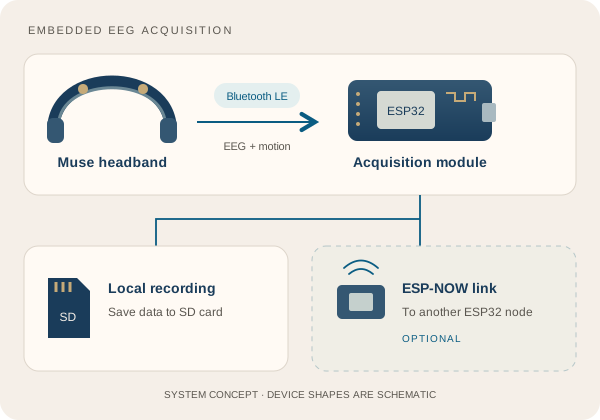
MuseCroc acquires raw EEG and motion data directly from Muse headbands over Bluetooth Low Energy. An external ESP32 module handles recording and optional communication with a central receiver, reducing dependence on phone applications and computer-based acquisition pipelines.
My Contribution
My contribution included system integration and acquisition architecture, experimental protocols, and minor firmware contributions. I also supported embedded troubleshooting, data review, documentation and visualization.
Aydin Hosseingholizadeh made foundational technical contributions to the implementation.
How the System Works
Headband connection and sample reconstruction
The ESP32 discovers compatible Muse headbands and subscribes to their BLE sensor notifications. Packet decoding reconstructs EEG samples and motion measurements, preserving the samples packed into each notification.
Acquisition and storage
The updated firmware uses ESP-IDF and NimBLE. FreeRTOS tasks and buffers separate acquisition from storage and communication, reducing blocking in the recording path. Measurements can be saved locally to an SD card.
Optional multi-device communication
Acquisition nodes can send measurements over ESP-NOW to a central ESP32 receiver, the Meta-MuseCroc. The thesis describes a many-to-one arrangement, with timestamps and delivery callbacks used to examine transfer timing.
From Proof of Concept to Updated Acquisition
| Stage | What changed |
|---|---|
| Initial proof of concept | Direct headband connection, SD recording and ESP-NOW communication were demonstrated. Incomplete BLE sample reconstruction limited the effective usable EEG rate to approximately 21 Hz. |
| Updated architecture | Refined decoding and buffering restored the full 256 Hz EEG stream reported in the thesis. The firmware moved to ESP-IDF with NimBLE and more explicit task and connection management. |
The outdoor trial used the initial implementation; the later jaw-clenching test assessed the updated acquisition system.
Experiments and What They Show
Outdoor acquisition with two participants
Two participants wore independent Muse S–MuseCroc systems during an approximately five-minute outdoor walking trial. The thesis reports stable BLE connections, local SD recording and transmission to a central receiver. Incomplete sample reconstruction limited the effective EEG recording rate to approximately 21 Hz.
Jaw-clenching protocol with the updated system
The updated system was tested using an approximately ten-second resting baseline followed by six jaw-clench events. Recorded transients corresponded to the clench events and were distinguishable from the baseline.
These experiments demonstrate acquisition behavior in the tested setups. The jaw-clenching response is a muscle artifact observed in the EEG recording; it provides a preliminary acquisition check rather than clinical validation.
Publications and Further Reading
MASc thesis: Embedded EEG Acquisition and Accelerated Adaptive Chirplet Transform for Scalable Signal Analysis, Nishant Kumar, University of Toronto, 2026. Chapter 3 describes the architecture, development stages and experiments; Section 3.0.1 discusses individual contributions.
Related paper: A. Hosseingholizadeh, N. Kumar and S. Mann, Portable EEG-Based Data Acquisition and Multi-Sensor Integration Using the Muse S Headband, IEEE ICCAD, 2025.
Based on Chapter 3 of the thesis. The conference paper describes an earlier stage of the system.